

A trucker’s logbook can decide who wins a Texas 18-wheeler case. Federal hours-of-service rules cap how long a driver can stay behind the wheel, and the electronic log records every minute. When that record shows a driver blew past the 11-hour driving limit before a crash, you have hard proof that fatigue, not bad luck, put you in the hospital. This post explains the rules on truck driver hours of service in Texas, how the logs expose violations, and why you have to move fast to save the data before it disappears.
Key Takeaways
- Federal law limits most truckers to 11 hours of driving inside a 14-hour on-duty window, with a 30-minute break required after 8 hours of driving.
- Electronic logging devices record the driver’s real hours, so a logbook can prove fatigue caused your crash.
- Texas intrastate drivers follow similar state rules, including a 12-hour driving cap.
- Log data gets overwritten, so a preservation letter needs to go out quickly.
Federal hours-of-service rules cap how long a trucker can drive
The Federal Motor Carrier Safety Administration writes the hours-of-service regulations, and they live in the federal code at 49 CFR Part 395. These federal regulations exist for one reason: a tired trucker steering 80,000 pounds is a danger to everyone sharing the road. The core limits for property-carrying commercial drivers are simple to state and easy to check.
- Eleven hours of driving. A driver may drive a maximum of 11 hours after taking 10 consecutive hours off duty, under 49 CFR 395.3.
- A 14-hour window. Driving is not allowed after the 14th hour on duty, even if the driver stopped for meals or loading during that stretch.
- A mandatory 30-minute break. After 8 cumulative hours of driving, the driver must take at least a 30-minute break before driving again.
- Weekly caps. A driver cannot exceed 60 hours on duty in 7 days or 70 hours in 8 days. A 34-hour rest period restarts that weekly clock.
These HOS regulations apply to interstate truckers hauling freight across state lines through Central Texas on I-35 and I-10. When a carrier pushes a driver to skip the break or roll past hour 14 to hit a delivery deadline, the company is choosing schedule over safety. Some of that freight now runs on SH 130’s 85 mph toll lanes, where a tired driver has even less room for error.
Driver fatigue is a documented cause of large truck crashes
Fatigue does to a driver’s reaction time what alcohol does. A trucker who misses the required rest reacts slower, drifts across lanes, and sometimes falls asleep at highway speed. The stakes are heavy. The FMCSA reported that 5,340 people were killed in crashes involving large trucks in 2024, a 2.5 percent drop from the prior year but still an average of more than 14 deaths every day, per FMCSA Large Truck and Bus Crash Facts.
Road safety rules only work when carriers follow them. That is why the hours-of-service framework matters so much in a Texas 18-wheeler case. If the driver who hit you was on hour 16, the rulebook already labels that as unsafe. Your job, with a lawyer’s help, is to prove it happened. Fatigue rarely announces itself at the scene, so the paper trail does the talking. A driver will almost never admit to the responding officer that they nodded off or pushed past the limit. The logbook does not have that incentive to shade the truth.
The ELD mandate turned logbooks into hard evidence
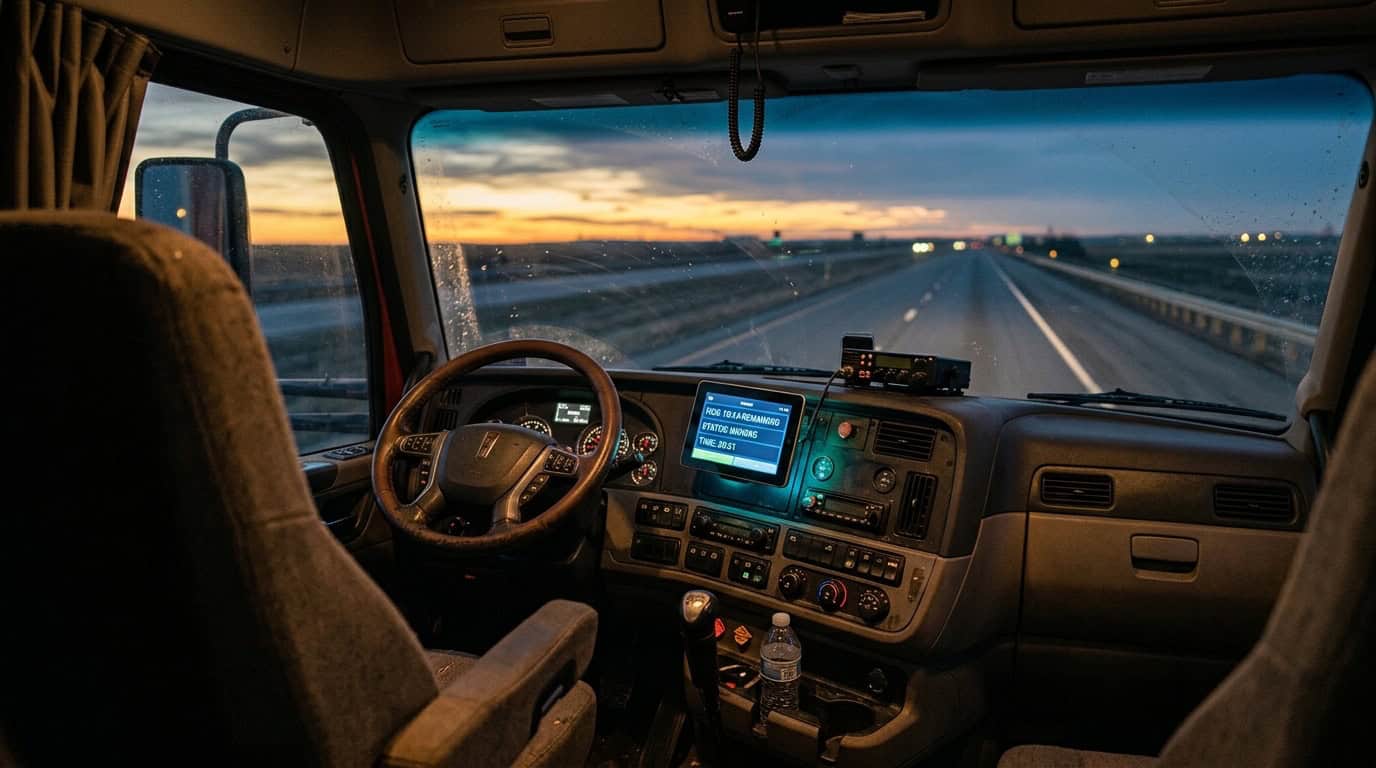
Truckers once kept paper logs, which were easy to fudge. That changed with the electronic logging device rule. The ELD mandate took full effect on December 18, 2017, and it requires most interstate commercial drivers to record their hours automatically through a device wired into the truck’s engine.
An electronic logging device tracks engine hours, vehicle movement, miles driven, and duty status without the driver writing anything down. That makes the record much harder to fake. When we pull the ELD data after a crash, we can line up the driver’s actual driving hours against the federal limits and see exactly where the rules broke down. The device often captures the moments right before impact, including speed and whether the truck was moving when it should have been parked.
Texas truck drivers on intrastate routes follow similar state rules
Not every big rig crosses a state line. A driver hauling gravel from Bastrop to Buda may run entirely inside Texas, which makes them an intrastate carrier. Texas truck drivers on those routes answer to state hours-of-service rules that the Texas Department of Public Safety adopted, and the numbers track the federal ones closely.
Under the Texas rules, an intrastate driver may drive up to 12 hours after 8 consecutive hours off duty, cannot drive after 15 hours on duty, and cannot drive after 70 hours on duty in 7 days. A 34-hour break restarts that clock. Texas also adopted the electronic logging requirement for intrastate carriers, so the same log evidence exists whether the truck was interstate or local. If you were hurt by a local hauler, an experienced Texas truck accident attorney can figure out which set of service regulations applied and whether the driver broke them.
Spoliation: why the logs have to be preserved fast
Here is the problem. ELD providers are only required to retain a driver’s records for a limited window, and carriers routinely overwrite or purge old data on a rolling schedule. Truck event data recorders, sometimes called the truck’s black box, can loop and record over the crash data within days. If nobody acts, the single best proof of a fatigued driver can vanish before a claim is even filed.
That is where a spoliation letter comes in. Spoliation is the legal term for destroying evidence. A preservation letter puts the trucking company on formal notice to keep the logs, the ELD data, the black box download, dispatch records, and the driver’s qualification file. If the company destroys that evidence after getting the letter, a Texas court can instruct the jury to assume the missing records would have hurt the carrier. That instruction is called an adverse inference, and it can shift the weight of a whole trial. Sending that letter early is one of the first things a truck accident case demands, often within days of the crash rather than weeks.
What the logbook can prove in your case
A complete set of records paints a full picture of the trip that ended with your crash. Read together, the driver’s logs and the carrier’s files can show fatigue was not a guess but a fact.
- Hours over the limit. Driving time that runs past 11 hours, or a shift that pushes past the 14-hour window.
- Skipped breaks. No 30-minute rest after 8 hours behind the wheel.
- Falsified duty status. A log marking the driver off duty while fuel receipts, GPS pings, or toll records show the truck was rolling.
- Company pressure. Dispatch messages and pay records that reward drivers for beating the clock, which points to carrier liability, not just driver error.
Each of those findings ties the crash to a broken federal rule. That connection is what turns a hard case into a provable one.
If a fatigued trucker hurt you or someone you love on a Texas highway, do not wait for the log data to disappear. Our Central Texas trial team moves quickly to preserve the evidence and build the case. Talk with our Buda truck accident lawyers about what your trucker’s logbook may reveal.
Frequently asked questions
How many hours can a truck driver legally drive in Texas?
An interstate driver hauling freight through Texas may drive up to 11 hours after 10 consecutive hours off duty, and cannot drive past the 14th hour on duty. A driver running only inside Texas as an intrastate carrier may drive up to 12 hours after 8 hours off, with a 15-hour on-duty cap. Both must stop after 8 hours of driving for a 30-minute break.
What is an ELD and why does it matter after a truck crash?
An ELD, or electronic logging device, is hardware wired into the truck’s engine that automatically records the driver’s hours, movement, and duty status. Because it records data without the driver writing it down, it is much harder to falsify than an old paper log. After a crash, that record can show whether the driver exceeded the federal hours-of-service limits.
Can a trucking company delete the logbook before my case starts?
Log and event-recorder data can be overwritten or purged on a rolling schedule, sometimes within days or weeks. A preservation letter, sent early, puts the carrier on legal notice to keep the ELD data, black box download, and driver records. If the company destroys that evidence after receiving notice, a Texas court can penalize it at trial.
Does the trucking company share blame if the driver broke hours-of-service rules?
Often, yes. If dispatch records, pay structures, or messages show the carrier pushed the driver to beat delivery deadlines by skipping breaks or driving past the limit, the company can be held liable alongside the driver. Trucking companies are responsible for monitoring their drivers’ hours and cannot knowingly allow violations.
How is a Texas 18-wheeler case different from a regular car accident claim?
Truck cases involve layers of federal and state safety regulations, multiple potentially liable parties, and time-sensitive electronic evidence that a car wreck simply does not have. The logbook, ELD data, and driver qualification file can make or break the claim. Because that evidence disappears, acting quickly matters far more than in a typical fender bender.
What should I do right after a truck accident in Central Texas?
Get medical care first, then report the crash and gather what you can, including photos, the truck’s DOT number, and witness contacts. Avoid giving a recorded statement to the trucking company’s insurer. Contact a truck accident attorney promptly so a preservation letter can go out before the driver’s logs and black box data are overwritten.