
If a rented Lime or Bird scooter puts you in the ER on an Austin street, liability usually falls on the person or company whose carelessness caused the crash. In most cases the strongest claim is against a negligent driver who hit you, not the scooter company. That is because the rental app you tapped to start the ride almost always makes you agree to a liability waiver and a private arbitration clause, which sharply limits what you can pursue against Lime or Bird in court. Below we break down every party who can be on the hook, and why an ordinary negligence claim against a careless motorist is often your clearest path to real money.
Key Takeaways
- A negligent car or truck driver who hits a scooter rider is usually the most collectible defendant, because that claim runs on ordinary Texas negligence law.
- Claims against the scooter company are blunted by the rental user agreement’s liability waiver and arbitration clause, which you accept when you start the ride.
- The City of Austin can be liable for a dangerous street or dock placement, but the Texas Tort Claims Act caps and short notice deadlines make those claims hard.
- Texas gives you two years to file, and your own share of fault can reduce or bar what you recover.
Who can be on the hook after an Austin scooter crash
Electric scooters share the road with cars, cyclists, and people on foot, so a single crash can involve several potentially responsible parties. A careless motorist is one. The scooter company is another if the device failed. The City of Austin is a third if the road itself was the hazard. And sometimes another scooter rider or a pedestrian caused the collision. Sorting out who pays starts with one question: whose unreasonable conduct actually caused your injury?
Texas answers that with plain negligence. To win, you show the at-fault party owed you a duty of care, broke it, and caused your harm. This same framework applies to nearly every e scooter accident claim, whether the defendant is a driver, a corporation, or a government body. The difference is how hard each one is to reach.
A negligent driver is usually the strongest claim
Most serious scooter injuries in traffic come from a car, SUV, or truck. A driver who runs a light, turns without looking, opens a door into a bike lane, or simply fails to yield owes every road user a duty of ordinary care. When that driver hurts a scooter rider, the claim is a standard motor vehicle negligence case backed by the driver’s auto liability insurance.
This path avoids the traps built into the rental contract. You are not fighting the scooter company’s fine print. You are pursuing a driver and an insurer under the same rules that govern any Austin car wreck. That is why a careful Austin personal injury attorney will look first at whether a motorist caused or contributed to the crash before wrestling with harder targets.
One caution: Texas uses proportionate responsibility under Chapter 33 of the Civil Practice and Remedies Code. If you are found partly at fault, your recovery drops by your percentage, and if you are more than 50 percent at fault you recover nothing. Riding against traffic or blowing a stop sign can cut into your claim, so the facts matter.
Suing the scooter company is harder than it looks
People assume Lime or Bird is the obvious defendant. In practice, the rental user agreement you accept to start the ride is designed to keep you out of court. Two clauses do the heavy lifting.
First, the liability waiver. When you tap to start the ride, you agree the company is not responsible for many kinds of harm and that you assume the risks of riding. Texas courts do enforce clear waivers, though they will not shield a company from its own gross negligence or from claims that public policy protects.
Second, the arbitration clause. The agreement usually forces disputes with the scooter company into private arbitration and waives your right to a jury and to join a class action. That means no public courtroom, a private arbitrator, and rules the company helped write. It does not erase your claim, but it changes the venue and the leverage.
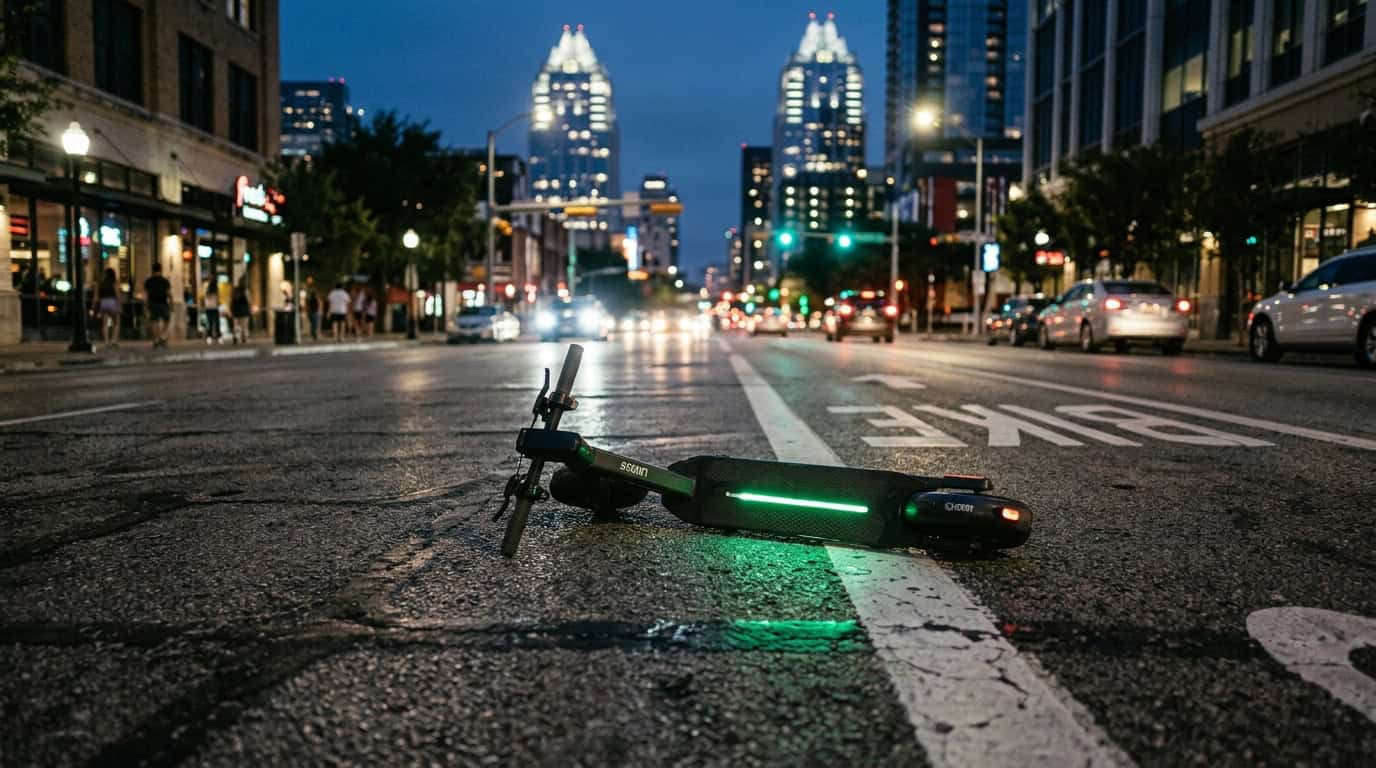
You can still have a real case against the company when a genuine defect caused the crash. A brake that fails, a throttle that sticks, a stem that snaps, or a scooter the company knew was damaged and put back on the street can support a product or maintenance claim. These are the facts that survive a waiver, because a company cannot contract its way out of putting a dangerous machine in your hands. Preserve the scooter’s ID number and photograph the device, since proving the defect is the whole ballgame.
When the City of Austin may share the blame
Some crashes trace back to the street, not a rider or a company. A crater-sized pothole, a missing manhole cover, or a corral that dumps scooters into a traffic lane can turn a routine ride into a wreck. The City of Austin runs the shared micromobility program and sets where devices may park, so a dangerous condition it created or ignored can expose it to a claim.
Governmental immunity makes this the hardest road of all. The Texas Tort Claims Act waives the city’s immunity only in narrow situations, mainly certain premises defects and vehicle-related harm. Even when it applies, Section 101.023 caps a city’s liability at $250,000 per person and $500,000 per occurrence for bodily injury, no matter how severe your losses. Austin also demands prompt written notice of a claim, often far sooner than the general filing deadline, and missing that notice can end the case before it starts.
Another rider or pedestrian can be liable too
Not every crash involves a car or a defect. Another scooter rider who weaves through a crowd and clips you, or a pedestrian who steps off a curb without looking, can be the negligent party. These claims run on the same ordinary negligence rules, but collectibility is the practical hurdle. A private individual may have little or no insurance to cover your medical bills, which is another reason a motorist with auto coverage is often the better target.
What Austin’s scooter numbers say about the risk
The scale of shared scooters helps explain why austin scooter accidents keep landing people in the ER. Austin lets Lime run up to 3,700 scooters plus 180 e-bikes and Bird up to 3,000 scooters, according to the city’s shared mobility program. In 2024 the city cut roughly 2,000 devices and lowered speed limits to curb crashes, and helmets are required for riders under 18.
The injury trend is stark. The U.S. Consumer Product Safety Commission’s national injury surveillance system recorded about 118,000 e-scooter injuries treated in emergency departments in 2024, nearly double the prior year. CPSC also reported that e-scooter and e-bike injuries jumped about 21 percent in a single recent year. Researchers at UC San Francisco found e-scooter injuries have soared across the country as ridership climbs. Bird scooter accidents and Lime crashes are a growing slice of that total in dense, fast-moving cities like Austin.
Deadlines and evidence that decide your case
Texas gives you two years from the crash to file a personal injury lawsuit under Section 16.003 of the Civil Practice and Remedies Code. Claims against the City of Austin face a much shorter notice window, so waiting is the enemy. In the hours and days after a crash, save the ride receipt and scooter ID, photograph the device and the scene, get the driver’s insurance and any witness contacts, and keep every medical record. A seasoned scooter accident lawyer uses that evidence to pin fault on the right party before insurers build their own story.
If a rented Lime or Bird crash left you hurt on an Austin street, you do not have to guess who owes you. Bring the facts to our Austin injury team and let us map every path to recovery, from the driver who hit you to a defect claim the app’s fine print cannot bury. Talk with an Austin personal injury attorney at Key Trial Lawyers about what your case is really worth.
Frequently asked questions
Can I sue Lime or Bird after a scooter crash in Austin?
You can, but the rental user agreement you accept to start the ride usually includes a liability waiver and an arbitration clause that pushes disputes out of court and into private arbitration. Your strongest company claim is when a real defect caused the crash, such as failed brakes or a scooter the company knew was damaged. A defect claim can survive a waiver because a company cannot contract away the duty not to hand you a dangerous machine.
Who is usually the best party to pursue after a scooter accident?
A negligent motorist who hit you is often the strongest defendant. That claim runs on ordinary Texas negligence law and is backed by the driver’s auto liability insurance, so you avoid the scooter company’s arbitration clause and waiver entirely. It is also usually the most collectible source of money for medical bills and lost income.
Does the arbitration clause mean I have no case?
No. An arbitration clause changes where your dispute with the scooter company is decided, not whether you have a claim. It moves the fight from a public courtroom to a private arbitrator and often waives a jury and class actions. It also does not affect claims against a separate at-fault driver, since that person never was part of your rental contract.
Can I sue the City of Austin if a pothole or bad dock caused my crash?
Sometimes, but it is the hardest claim. The Texas Tort Claims Act waives the city’s immunity only in narrow situations and caps a city’s liability at $250,000 per person and $500,000 per occurrence. Austin also requires prompt written notice of a claim, often much sooner than the general deadline, so acting fast is essential.
What if I was partly at fault for the scooter accident?
Texas uses proportionate responsibility. Your recovery is reduced by your percentage of fault, and if you are found more than 50 percent at fault you recover nothing. Actions like riding against traffic or ignoring a stop sign can lower your award, so how the facts are presented matters a great deal.
How long do I have to file a scooter injury claim in Texas?
You generally have two years from the date of the crash to file a personal injury lawsuit under Section 16.003 of the Texas Civil Practice and Remedies Code. Claims against the City of Austin carry a much shorter notice deadline. Because evidence like the scooter ID and ride receipt disappears quickly, it is smart to talk with a lawyer soon after the crash.